

Ultrasonic Level Meter
Product Overview
An ultrasonic level meter is a non-contact, continuous level measurement device designed for liquids, slurries, and bulk solids. By emitting high-frequency acoustic pulses from a piezoelectric transducer and measuring the return time of the echo reflected off the media surface, the unit calculates distance without physical immersion.
Eliminating moving parts and direct material contact prevents mechanical wear, chemical fouling, and maintenance bottlenecks typical in corrosive or viscous environments. Available in compact integrated enclosures or split-mount configurations with remote sensor heads, these units integrate into existing control architectures via standard industrial protocols.
-
![Small Range Ultrasonic Level Sensor]() Small Range Ultrasonic Level SensorThe sensor probe emits ultrasonic pulses, which reflect off the liquid surface. By measuring the round-trip time of the sound waves, the sensor calculates the distance to the liquid surface,...read more
-
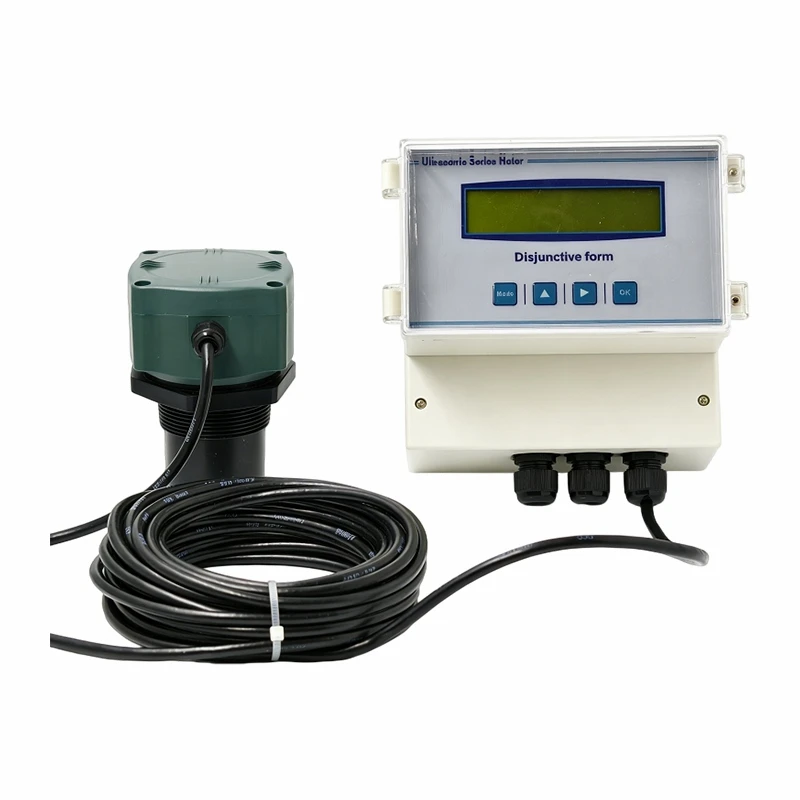
![Remote Type Ultrasonic Level Meter]() Remote Type Ultrasonic Level MeterThe series is an enhanced remote ultrasonic level meter for continuous non-contact level measurement in liquids and solids. It consists of probe and host, both of which are plastic leak-proof...read more
-
![Metal Housing Ultrasonic Level Meter]() Metal Housing Ultrasonic Level MeterThe UTG21‑H(E) is an integrated explosion‑proof ultrasonic level transmitter. It adopts the ultrasonic time‑of‑flight principle for **non‑contact liquid level measurement**, and is applicable to...read more
-
![UTG21-K Ultrasonic Level Meter]() UTG21-K Ultrasonic Level MeterUTG21-K Ultrasonic Level Transmitter is a professional industrial level measuring instrument designed for continuous, non-contact detection of liquid, paste and granule material level.read more
... -
![UTG21-P Ultrasonic Level Meter]() UTG21-P Ultrasonic Level MeterThe UTG21-P ultrasonic level meter includes several proprietary technologies, is safe and clean, with high precision and long service life, stable and reliable, and convenient to install and...read more
-
![UTG21-BE Explosion-proof Ultrasonic Level Meter]() UTG21-BE Explosion-proof Ultrasonic Level MeterUTG21-BE Ultrasonic Level Transmitter is a professional industrial level measuring instrument designed for continuous, non-contact detection of liquid, paste and granule material level.read more
... -
![UTG21-HE Explosion-proof Ultrasonic Level Meter]() UTG21-HE Explosion-proof Ultrasonic Level MeterUTG21-HE Ultrasonic Level Meter integrates multiple proprietary technologies, featuring safe and clean operation, high measurement precision, and a long service life.read more
● High... -
![UTG21-PR Remote Type Ultrasonic Level Meter]() UTG21-PR Remote Type Ultrasonic Level MeterThe UTG21-PR Ultrasonic Level Transmitter is a professional industrial level measurement device designed for continuous and non-contact detection of liquid, paste and granule material levels....read more
-
![UTG21-PS Remote Type Ultrasonic Level Meter]() UTG21-PS Remote Type Ultrasonic Level MeterUTG21-PS ultrasonic level meter is a high-performance non-contact liquid level measuring instrument..read more
● Easy to install and maintain
● Lightning and short-circuit protection... -
![UTG21-R Ultrasonic Level Meter]() UTG21-R Ultrasonic Level MeterThe UTG21-R Ultrasonic Level Transmitter is a professional industrial non-contact level measurement instrument, designed for continuous and accurate level detection of liquid, paste and granule...read more
-
![UTG21-W Ultrasonic Level Sensor]() UTG21-W Ultrasonic Level SensorThe UTG21-W Ultrasonic Distance Transducer is a professional industrial-grade ranging sensor engineered for accurate non-contact distance measurement.read more
● Small blind zone &... -
![UTG21-S Ultrasonic Level Sensor]() UTG21-S Ultrasonic Level SensorUTG21-S is high-performance industrial-grade ultrasonic sensing transducers designed for non-contact distance and liquid/solid level measurement, engineered to deliver reliable and accurate data...read more


Measurement & Testing Principle
The instrument operates on the time-of-flight acoustic pulse-echo principle:
Pulse Emission: The internal microprocessor triggers the piezoelectric ceramic transducer to emit a directional acoustic wave ranging from 20 kHz to 70 kHz.
Propagation & Reflection: The wave travels through the vapor space, strikes the target medium surface, and reflects an echo back to the transducer.
Echo Reception: The transducer converts the mechanical acoustic wave back into an electrical signal.
Transit Time Calculation: The embedded digital signal processor measures transit time (t). Distance (D) is computed via the formula:D = (c * t) / 2(where c represents the velocity of sound in the gas medium).
Temperature Compensation: Because sound velocity varies with gas temperature, an integrated temperature sensor measures internal ambient temperature in real time, automatically correcting the sound velocit
Product Types & Configurations
|
Series |
Configuration |
Housing Material |
Max Range (Liquid) |
Primary Application |
|
Compact Series |
Integrated single-piece |
PVDF / Cast Aluminum |
Up to 10 meters |
Water treatment basins, standard chemical totes |
|
Split Series |
Remote sensor + wall-mount display |
PP / Stainless Steel Flange |
Up to 30 meters |
Deep open channels, hazardous vapor zones |
|
Explosion-Proof Series |
Flameproof enclosure |
Epoxy-coated Aluminum |
Up to 15 meters |
Petrochemical fuel storage, combustible liquids |
Key Features
Advanced Echo Processing: Proprietary filtering algorithms differentiate true surface echoes from structural false echoes caused by internal tank fixtures or agitator blades.
Corrosion-Resistant Wetted Parts: Transducer faces molded in solid polyvinylidene fluoride or PTFE resist aggressive acid and alkali vapors.
Narrow Beam Angle: Acoustic emission angles restricted to less than or equal to 6 degrees minimize false reflections in narrow, tall silos or constricted risers.
Loss-of-Echo Diagnostics: Programmable fail-safe modes trigger immediately upon signal attenuation from heavy foam or excessive dust.
Dual-Compartment Enclosure: Die-cast aluminum housing isolates terminal wiring from the main circuit board, preventing moisture ingress during field cabling.

Technical Specifications
|
Parameter |
Specification Details |
|
Measuring Range |
0.4m to 30m (dependent on model and surface condition) |
|
Accuracy |
Plus or minus 0.25% Full Scale |
|
Resolution |
1 mm or 0.1% |
|
Blind Zone (Dead Band) |
0.25m to 0.5m |
|
Beam Angle |
Less than 6 degrees (at -3dB total angle) |
|
Operating Frequency |
20 kHz to 70 kHz |
|
Analog Output |
4 to 20 mA loop-powered, max load 750 ohms |
|
Digital Communication |
HART Protocol, RS485 / Modbus RTU |
|
Display |
4-digit LCD with optical keypad programming |
|
Power Supply |
24 VDC standard; 85 to 265 VAC optional |
|
Ingress Protection |
IP67 for integrated units; IP68 for remote sensor heads |
|
Process Connection |
G 2" thread, 2" NPT, or ANSI / DIN Flanges (DN50 - DN150) |
|
Ambient Temperature |
-40 degrees Celsius to +70 degrees Celsius |
|
Process Pressure |
-0.2 bar to +1.0 bar |
Applications
Municipal Wastewater Treatment
Sludge holding tanks, grit chambers, influent wet wells, and open-channel flumes using integrated linearization curves.
Chemical & Petrochemical Storage
Hydrochloric acid, sodium hydroxide, and wastewater neutralization basins requiring non-contact wetted paths.
Food & Beverage Processing
Utility water tanks, syrup storage, and grain silos utilizing dust-compensating gain adjustments.
Mining & Aggregate
Slurry thickener basins and dry mineral powder storage silos.
Installation & Operating Considerations
Mounting Location
Install the transducer perpendicular (90 degrees) to the liquid surface, positioned away from direct inflow streams to avoid turbulence and splashing.
Clearance Requirements
Ensure the lowest liquid level remains below the sensor dead band to prevent unmeasured saturation zones and erratic output.
Nozzle Extension
If mounting via a nozzle, the inner diameter must match frequency requirements, and the bottom edge of the transducer face must extend past the inner vessel ceiling.
Solar Shielding
Outdoor direct-sunlight installations require sunshade accessories to prevent internal electronics from exceeding the +70 degrees Celsius thermal limit.
Manufacturing & Quality Control

Transducer Assembly
Piezoelectric ceramic crystals undergo automated polarization bonding and vacuum encapsulation to eliminate internal air voids.

Acoustic Calibration Test Bench
Units undergo a 12-hour automated thermal chamber burn-in cycle ranging from -30 degrees Celsius to +60 degrees Celsius to verify zero-point drift and phase stability.
Pressure & Sealing Verification
Sensor assemblies are pressure-tested in pneumatic chambers at 1.5 times rated working pressure to guarantee ingress integrity before final electronic board assembly.

Traceability
Each meter features a laser-engraved serial number tied to an individual calibration certificate documenting exact distance-error curves across 5 calibration points.
Customization & OEM
Private Labeling
Custom laser-engraved nameplates bearing client branding, model nomenclature, and proprietary serial numbering sequences.
Software Firmware Modification
Tailored Modbus register maps, custom tank geometry calculation tables, and multi-language menu structures.
Specialized Materials
Alternative wetted materials and custom thread or flange drillings to match legacy plant retrofit footprints.
Selection Guide
Determine Medium State
Select standard PVDF transducer tips for clean liquids, or higher-frequency narrow-beam models for heavy dust or fine granular solids.
Calculate Maximum Range
Multiply maximum vessel depth by 1.3 to account for dynamic surface turbulence and foam absorption margins.
Select Power & Comms
Specify 2-wire 4 to 20mA HART loops for standard control room integration or RS485 Modbus for multi-drop PLC network topologies.
Verify Hazardous Area Classifications
Choose explosion-proof housing variants if installation occurs within hazardous atmospheres.
Frequently Asked Questions
Dalian Yheng Technology Co., Ltd. is one of the leading ultrasonic level meter manufacturers and suppliers in China, also supports customized service. We warmly welcome you to buy high quality ultrasonic level meter in stock here from our factory. Contact us for more details.
UTG21 BE Explosion proof Ultrasonic Level Meter, UTG21 HE Explosion proof Ultrasonic Level Meter, High Precision Ultrasonic Level Transmitter